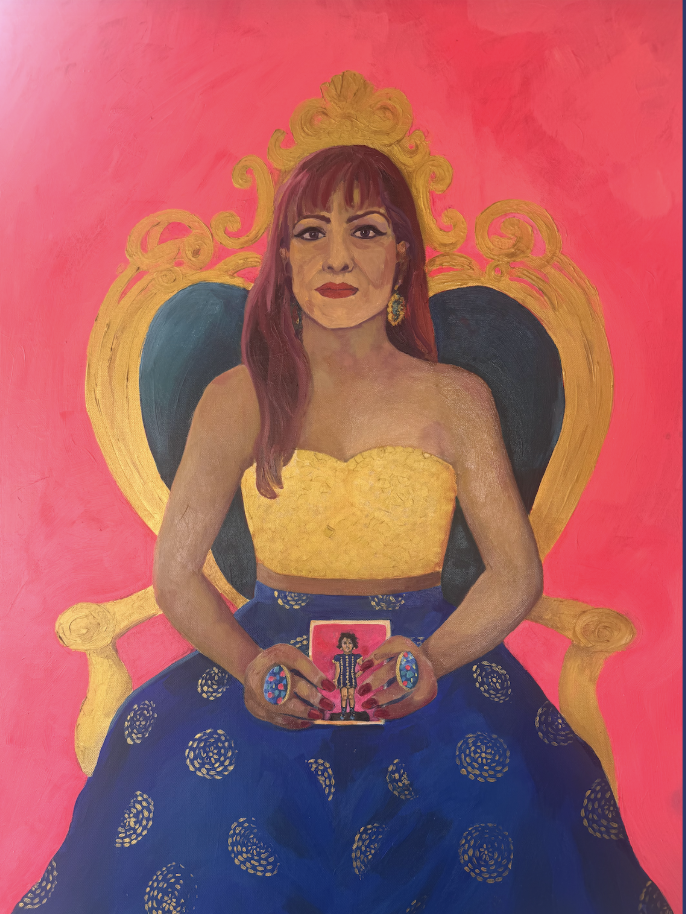
“Sangeeta and Minnie”
Sangeeta Pillai, feminist podcaster, writer and all round bad-ass woman, was the inspiration for my entire Portrait Stories series.
Having connected with her through work I’d already been reading her memoir, Bad Daughter, and it had affected me deeply. In particular, I was struck by the idea that we carry our childhood selves with us into adulthood. I remember crying on the train and messaging Sangeeta to tell her that her words had made me feel seen.
Not long afterwards, on another train journey to a party in York, I had the idea for a series of portraits inspired by creative people. At the time I called it Muse & Makers, and I spent much of that journey creating a digital portrait of Sangeeta (see below).
I’d been following her story on Instagram and knew that she had celebrated the publication of Bad Daughter as her own ‘wedding’…to herself. She had spent years creating the book and wanted to give that achievement the ceremony and significance traditionally afforded to marriage. That gave me the idea of putting Sangeeta on an Indian wedding throne.
I constructed that first portrait from different images and ideas rather than a single photograph. I borrowed the extraordinary blue-and-gold outfit from one photograph, but created a new pose: Sangeeta sitting upright on her throne, looking directly at us. Her clothes, jewellery, make-up and use of colour are very much part of how she expresses herself, so I wanted the portrait to have that same sense of unapologetic visibility. Sangeeta Portrait
And then there is the pink. Pink is so much a part of Sangeeta’s visual world and the identity surrounding Bad Daughter that it became the natural backdrop: exuberant, feminine and impossible to ignore. Against it, the blue and gold of her clothes and the gold of the throne became almost jewel-like.
On the Sunday morning, I sent Sangeeta my digital portrait with a slightly audacious question: would she consider being one of my sitters?
She said yes! (I treasure that WhatsApp voice note).
When Sangeeta eventually came to sit for me, in Soho, the portrait became much more personal. The photographs I’d originally used showed her with softer brown hair, but the woman who arrived had striking plum-red hair. I loved it and decided to paint the Sangeeta sitting in front of me rather than remain faithful to my original references.
But the most important change came through our conversation.
Sangeeta told me about “Minnie”, a childhood photograph of herself taken in Kerala. As a little girl, she was taken to a photographer’s studio and instructed to smile and put her hand down. She refused. She stood there defiantly, hand on hip, entirely herself. The photographer displayed the photograph in his window and, according to family lore, other parents began asking for photographs of their children like Minnie.
I’d originally intended Sangeeta to hold a copy of her book, Bad Daughter. Instead, I put Minnie into her hands.
It brought me back to the idea in the book that had affected me so profoundly in the first place, and to something Sangeeta said during our conversation: “We’re all little children walking around in adult bodies.”
Those words became part of the finished painting. And Minnie became its emotional centre: the stubborn little girl still present within the accomplished writer and creator sitting on her throne.
Months later, Sangeeta came back to Oxfordshire and I was finally able to show her the finished painting. We spent a special day together, including visiting Blenheim Palace, where her portrait would soon hang.
It happened at another moment of change. Sangeeta had packed up her life in London and was about to leave for six months in Kerala to begin her next chapter.
There was something beautifully circular about that: from the little girl in Kerala, to the woman on the throne, and now back to Kerala to begin again.
The digital portrait
Where this started…a portrait on a train, a WhatsApped ‘would you…’, and a whole series of Portrait Stories inspired by creative people who I admire.
Meet the Team
-
![]()
Monet Goode
FOUNDER
With a vision for building something meaningful, our founder brings a blend of big-picture thinking and hands-on experience.
They set the tone for everything we do. -
![]()
Emmett Marsh
SALES MANAGER
Focused, approachable, and driven by results, our sales manager is all about building strong relationships. They help connect people to the right solutions—with clarity and care. -
![]()
Eleanor Parks
MARKETING DIRECTOR
Creative and strategic in equal measure, our marketing director brings fresh ideas to every campaign. They turn insights into action and help our message resonate with the right audience. -
![]()
Karl Holland
CUSTOMER SERVICE MANAGER
Friendly, attentive, and always ready to help, our customer service manager ensures every interaction is a positive one. They keep communication clear, timely, and human.