“Your Best Chapter Is Not Yet Written”
Writer, strategist and storyteller
Heidi Stephens is a writer, strategist and storyteller whose work moves effortlessly between advertising, live cultural commentary and fiction. For years she was best known to me through her brilliantly acerbic Guardian liveblogs of Strictly Come Dancing, before I discovered that her other life was remarkably close to my own: brand and marketing strategy. She is also a published novelist, a long-time Eurovision writer and an exceptionally distinctive communicator. Sharp, funny, stylish and fiercely observant, Heidi has an enviable ability to understand people — how they behave, what they reveal and what makes a story worth telling.
I knew Heidi’s writing long before I knew Heidi.
For years, I was an obsessive reader of her Guardian liveblog of Strictly Come Dancing. In fact, I think I may have been a bigger fan of Heidi’s liveblog than I was of Strictly itself. I would watch the Saturday and Sunday programmes and then always, always read what Heidi had written afterwards.
What I loved was not simply that she was funny. She has a wonderfully acerbic wit, but underneath it is an extraordinary eye for people. She notices the tiny things: what somebody is wearing, the way they move, an awkward expression, a strange piece of staging, some tiny human detail that suddenly tells you everything. Her writing is sharp, but it is also incredibly observant.
Then, one day, she mentioned her Twitter account in one of the liveblogs. I looked her up and discovered something I hadn’t expected at all.
Her day job was strategy.
Advertising and marketing strategy, essentially the same world I worked in.
From there we developed one of those very contemporary friendships that begins virtually. Over quite a long period we got to know one another through social media, Instagram and LinkedIn, until eventually Heidi joined my team at RAPP.
My interview process with her was perhaps not entirely conventional. It involved a day swimming at Soho Farmhouse and quite a lot of me fangirling. I had, however, done my due diligence. I had checked with Ian, a friend and one of Heidi’s former bosses, that she was every bit as brilliant professionally as I suspected she would be.
She was.
The thing that connects all the different versions of Heidi is storytelling.
She is an exceptional strategist because she can take something complicated and turn it into a story people immediately understand. She writes brilliant presentations. She writes brilliant award entries. I have judged work from her agency without knowing for certain that she had written it and still found myself thinking, that sounds like Heidi. She has a voice that is completely her own.
That same voice runs through her fiction.
During lockdown, Heidi began writing romantic novels, and what started as another creative outlet became an entirely new strand of her life. Her books deal with the messy, occasionally gnarly realities of contemporary relationships, but with humour, warmth and characters who feel very much alive.
They are optimistic without pretending that life is uncomplicated.
I sometimes recognise little characteristics that remind me of people we both know, and I continue to live in hope that one day I might find a tiny fictional version of myself hidden somewhere in a Heidi Stephens novel.
She has also spent years writing around Eurovision, travelling out to the event and becoming part of that extraordinary two-week world of spectacle, fandom, music and sequins.
And perhaps that makes the photograph I eventually chose for this painting particularly appropriate.
The portrait process with Heidi was slightly different from the others.
I did originally have a sitting with her. We were going out to a party and I took photographs beforehand. They were lovely photographs: softer, more relaxed, very much two friends sitting together.
But when I returned to them, something felt missing.
They contained Heidi, but they didn’t quite contain enough Heidi-ness.
Because Heidi has a very strong sense of her own style.
There is also an interesting duality to her. She loves the great outdoors. She hikes with her husband Pip and their Labrador, Mabel, and there is a very grounded, earthy, practical side to her.
There is hiking Heidi.
And then there is glamorous Heidi.
For this painting, I chose glamour.
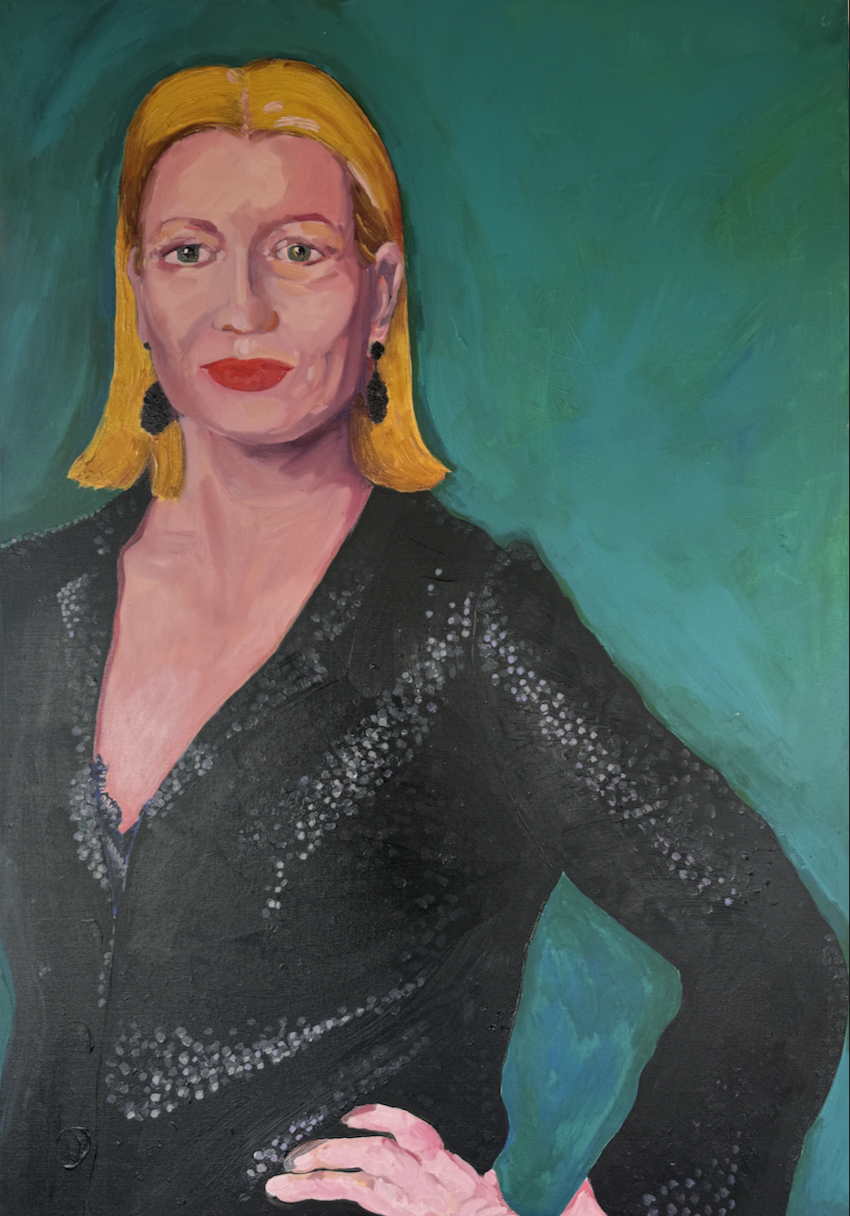
With Heidi’s permission, I worked from a photograph taken at Eurovision by photographer Sarah Louise Bennett. Heidi was wearing an extraordinary black sequinned Zara suit. She looked strong, glamorous, assured and completely herself.
Reference photograph: Sarah Louise Bennett (@slb_photo), used with permission.
There was something about that image I couldn’t let go of.
The hand on the hip.
The black sequins.
The directness of the pose.
The little knowing smile.
She looked as though she knew exactly where she belonged.
This portrait contains less overt storytelling symbolism than many of the others in the series. There are no objects to decode, no childhood photograph, no amulets, bottles or hidden references.
Instead, the story is carried by Heidi herself.
I simplified the original photographic setting and removed the architecture behind her completely, placing her against a saturated teal background. It allowed the blonde hair, pink skin and black suit to become almost graphic shapes.
And it shifted the portrait away from a particular Eurovision corridor and towards something more distilled.
An attitude.
A presence.
A way of occupying space.
The sequins matter, but not simply because Heidi likes clothes.
To me they have become shorthand for something about the way she lives.
Heidi knows what she wants. She is unusually clear about how she wants her life to work. She is good at boundaries. She invests in her friendships, her work, her writing, her home, her health, her relationship and the things that bring her joy.
There is something very intentional about her.
She is also relentlessly curious. She observes people. She understands character. She sees humour in situations other people might miss.
Perhaps that is why she has always been such a compelling writer.
And perhaps it is why I wanted this painting to feel less quiet than my original photographs of her.
Because although hiking Heidi is every bit as real as glamorous Heidi, I wanted to paint the woman who walks into the room already looking as though she has noticed everything.
The woman with the wit.
The storyteller.
The strategist.
The novelist.
The observer.
The woman in the sequinned suit.
Heidi and I stopped working together not long after I joined that business, but there is a lovely piece of serendipity in where this portrait has eventually landed.
As I finish the painting and prepare for this exhibition, I am also about to begin another professional chapter.
And Heidi is going to become one of my colleagues again.
We have somehow gone full circle.
She is also going to see this painting for the first time at the exhibition opening, which makes me considerably more nervous than I would like to admit.
But I love this portrait.
Because I think she looks beautiful in it, but more importantly she looks strong.
She has attitude.
She has humour.
She looks like somebody who knows herself.
Heidi doesn’t wear sequins every day. Quite often she is far more likely to be out on a long walk with Pip and Mabel.
But somehow that doesn’t really matter.
Because, to me, Heidi lives life in full sequin.
Get In Touch
If you're interested in purchasing this painting, or commissioning your own Portrait Story, please get in touch.